
Few video games match the extraordinary rise of Counter-Strike. Instead of launching from a major studio with a massive marketing budget, it originated as a passionate hobby project created by two developers who loved Half-Life and wanted a realistic, tactical experience. Over twenty years later, version 1.6 still runs on thousands of computers worldwide, and its structural DNA remains visible in virtually every competitive shooter on the market.
Here is the story behind its rise and the reasons it continues to attract players today.
The Origin: A Half-Life Modification
In 1999, Minh “Gooseman” Le and Jess Cliffe released the first beta of Counter-Strike as a free modification for Half-Life. The premise focused on pure tactical conflict: terrorists versus counter-terrorists, realistic weaponry, and single-life rounds where eliminated players had to spectate until the next round began.
Core Mechanics Shift:
Instant Respawns (Traditional Shooters)  ➔  Single-Life Tactical Rounds (Counter-Strike)
That single-life mechanic reshaped the genre. While traditional shooters of the era allowed instant respawns, Counter-Strike forced players to value every life, encouraging disciplined communication, methodical movement, and strategic planning.
Valve Steps In
The modification gained popularity so rapidly that Valve the studio behind Half-Life took notice. In 2000, Valve acquired the rights to Counter-Strike and hired both Le and Cliffe. Shortly after, a standalone retail version hit store shelves, introducing tactical multiplayer to millions of new players.
Throughout the early 2000s, frequent updates balanced firearms, refined map layouts, and improved netcode, laying the groundwork for what competitive players consider the definitive tactical shooter experience.
The Launch of Version 1.6
Counter-Strike 1.6 debuted in 2003 alongside Valve’s new digital distribution platform, Steam. The 1.6 update introduced key gameplay additions:
-
New Firearms: The FAMAS (CT) and Galil (T) expanded budget options.
-
Tactical Equipment: The tactical shield added new defensive dynamics.
-
Refined Engine: Optimized hitboxes and balance adjustments improved competitive consistency.
While initial adoption faced friction due to early Steam technical issues leading many players to temporarily stay on version 1.5-1.6 rapidly became the global standard within a year. Major esports tournaments adopted the version, community servers migrated, and the game established the precise mechanical feel it maintains today.
The Golden Era of Competitive Play
Between 2003 and 2012, Counter-Strike 1.6 anchored the global esports ecosystem. International tournaments like the Cyberathlete Professional League (CPL), World Cyber Games (WCG), and Electronic Sports World Cup (ESWC) drew massive online audiences and live crowds.
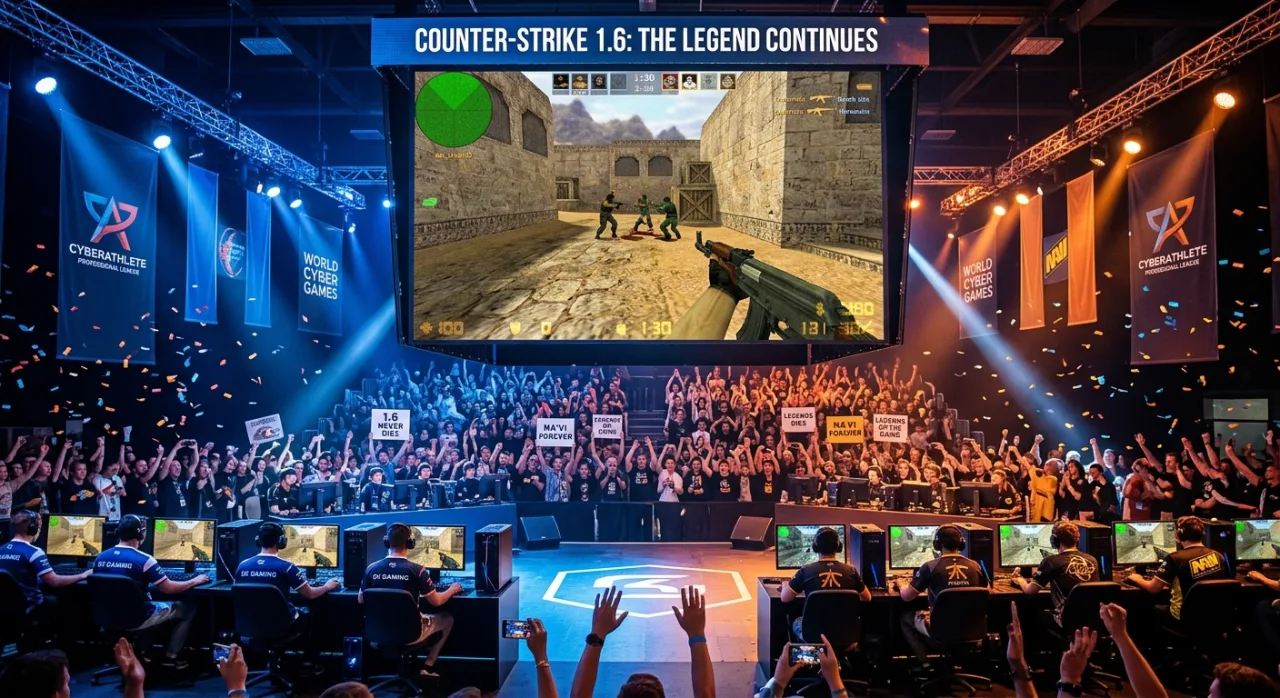
Legendary Rosters & Achievements
-
Ninjas in Pyjamas & SK Gaming: Defined early tactical play and dominated international circuits.
-
fnatic: Championed aggressive, highly coordinated playstyles.
-
Natus Vincere (Na’Vi): Made history in 2010 by winning three major world championships in a single calendar year.
Beyond professional arenas, the game became a staple of gaming culture. Internet cafes hosted local LAN events, schools developed informal clan rivalries, and an entire generation of tech enthusiasts learned networking fundamentals by configuring their own dedicated 1.6 servers.
Why 1.6 Outlasts Modern Successors
Despite Valve releasing Counter-Strike: Source (2004), Counter-Strike: Global Offensive (2012), and Counter-Strike 2 (2023), 1.6 retains a dedicated player base.
| Feature / Aspect | Counter-Strike 1.6 | Modern Counter-Strike Titles |
| Gunplay & Movement | Crisp, highly predictable recoil and movement physics | Updated physics with heavier player acceleration |
| Hardware Requirements | Runs smoothly on virtually any modern or legacy PC | Requires modern dedicated GPUs and high-end CPUs |
| Game Economy | Classic buy-menu system without cosmetic additions | Integrated skin economy, inspect animations, and cases |
| Matchmaking Style | Dedicated community servers and custom browser lists | Centralized automated ranking and matchmaking |
Key Timeline & Milestones
-
1999: First Counter-Strike beta released as a Half-Life mod.
-
2000: Valve acquires the franchise and hires the creators.
-
2003: Version 1.6 launches concurrently with Steam.
-
2004: Counter-Strike: Source releases on the Source Engine.
-
2010: Natus Vincere achieves the iconic “Grand Slam” by winning three major world titles in one year.
-
2012: Counter-Strike: Global Offensive (CS:GO) launches worldwide.
-
2023: Counter-Strike 2 launches, while classic 1.6 servers remain active and accessible.
Playing Counter-Strike 1.6 Today
Getting back into the game remains straightforward. Completing a clean Cs game download 1.6 setup allows players to access optimized client builds without manual patching. Simply launch the client, pick a server with low latency, and dive into round-based matches that feel as responsive today as they did twenty years ago.
New players will find an accommodating community. Active public servers feature regulars eager to teach round strategies, callouts, and recoil control, especially on legendary maps like Dust2, Inferno, and Mirage.
The Enduring Legacy
Counter-Strike 1.6 established the blueprint for modern tactical shooters. Its round economy, bomb defusal format, buy-menu structure, and team callouts served as the direct inspiration for modern competitive titles.
Ultimately, Counter-Strike 1.6 is not just a legacy title it is an active, fully playable piece of gaming history that delivers an unadulterated test of individual aim, team coordination, and raw tactical skill.
Leave a Reply