
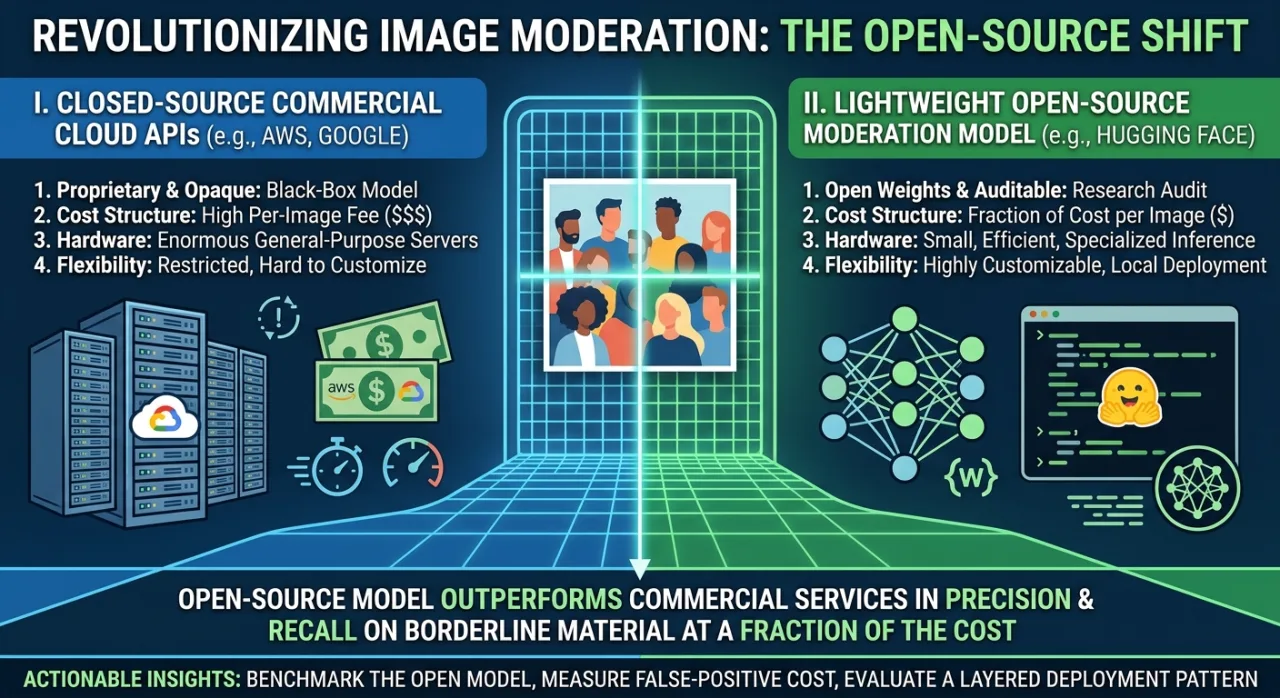
 The standout artificial intelligence release this week is a specialist image-classification model published as open source. It outscores commercial NSFW detection services from Amazon Web Services and Google on standard evaluations, while running at approximately one-hundredth of the cost per image.
Specialist models handle much of the invisible work of the internet by deciding in milliseconds whether an uploaded photograph is safe to publish. Previously, the default choice for this task relied on hyperscaler application programming interfaces (APIs) billed per thousand images. A credible open alternative fundamentally changes the build-versus-buy calculation for platform teams.
Performance and Cost Advantages
In benchmark testing, the open-source model delivers higher precision and recall on explicit-content categories compared to cloud services. The most significant gains occur on borderline material, where commercial systems traditionally default to overly conservative restrictions.
From an engineering perspective, inference is exceptionally cheap because the architecture is small and specialized. It performs a single task, eliminating the need for the massive general-purpose hardware required by frontier chatbots. Technical details circulate via arXiv, with weights hosted on Hugging Face.
Key Architectural & Operational Benefits
-
Complete Frame Scanning: Cheap inference unlocks design choices that per-call pricing forbids, such as scanning every frame of an uploaded video instead of sampling.
-
Retroactive Audits: Platforms can re-check historical libraries following policy changes without prohibitive costs.
-
Data Residency Compliance: Models can run locally on-device or in-region, satisfying strict data-residency requirements effortlessly.
Security, Operations, and the Commoditisation Trend
Open weights present a dual-edged sword, raising immediate cybersecurity concerns. Anyone can download the model, including bad actors probing for its precise blind spots. However, defenders emphasize that this same transparency allows independent researchers to audit false-positive patterns that disproportionately flag art, health information, or specific communities—biases that remain entirely hidden inside black-box cloud services.
Self-Hosting Considerations
Operationally, self-hosting introduces self-supporting responsibilities:
-
Model updates, graphics processing unit (GPU) capacity, and abuse spikes become internal engineering tasks.
-
The optimal deployment pattern is layered: using the open model as a fast first pass, a commercial API or secondary model to arbitrate uncertain cases, and human reviewers for final appeals.
The broader signal points toward commoditisation. Narrow, high-volume AI tasks—such as moderation, transcription, and tagging—are following the path of databases and web servers. Open implementations reach functional parity and win on price, while cloud vendors retreat to convenience, compliance, and support. Startups should benchmark the open model on their own traffic, measure false-positive costs honestly, and let data drive their next budget cycle.
Practical Evaluation and Deployment
Laboratory benchmarks can flatter a model that has yet to face a platform’s unique mixture of memes, screenshots, artwork, and adversarial uploads. Long-term behavior also matters as abuse communities adapt and image styles drift; maintaining an edge requires an active maintenance community.
Regulators will increasingly scrutinize automated decisions that affect user livelihoods, particularly for creators and sellers facing content removal. Transparent, auditable models prove significantly easier to defend in disputes than opaque commercial services.
Furthermore, switching costs are lower than platform folklore suggests. Because the open model exposes standard interfaces, it integrates directly behind existing internal review tools currently fed by commercial APIs—leaving moderator workflows, dashboards, and appeals processes untouched. Teams can easily run a shadow evaluation with zero user-visible changes, turning migration into a purely empirical decision based on proprietary platform data.
Leave a Reply