
Power board assembly is the specialized process of building printed circuit boards designed to convert, regulate, and distribute electrical power within electronic systems. Unlike standard signal boards that primarily manage data transfer, power boards must safely handle high voltages and heavy currents. Consequently, every phase of their manufacture is shaped by strict thermal, electrical, and mechanical demands. From industrial motor drives and telecommunication rectifiers to consumer chargers and medical electronics, the long-term reliability of an entire device depends heavily on the quality of its power distribution board.
1. Design, Sourcing, and Component Selection
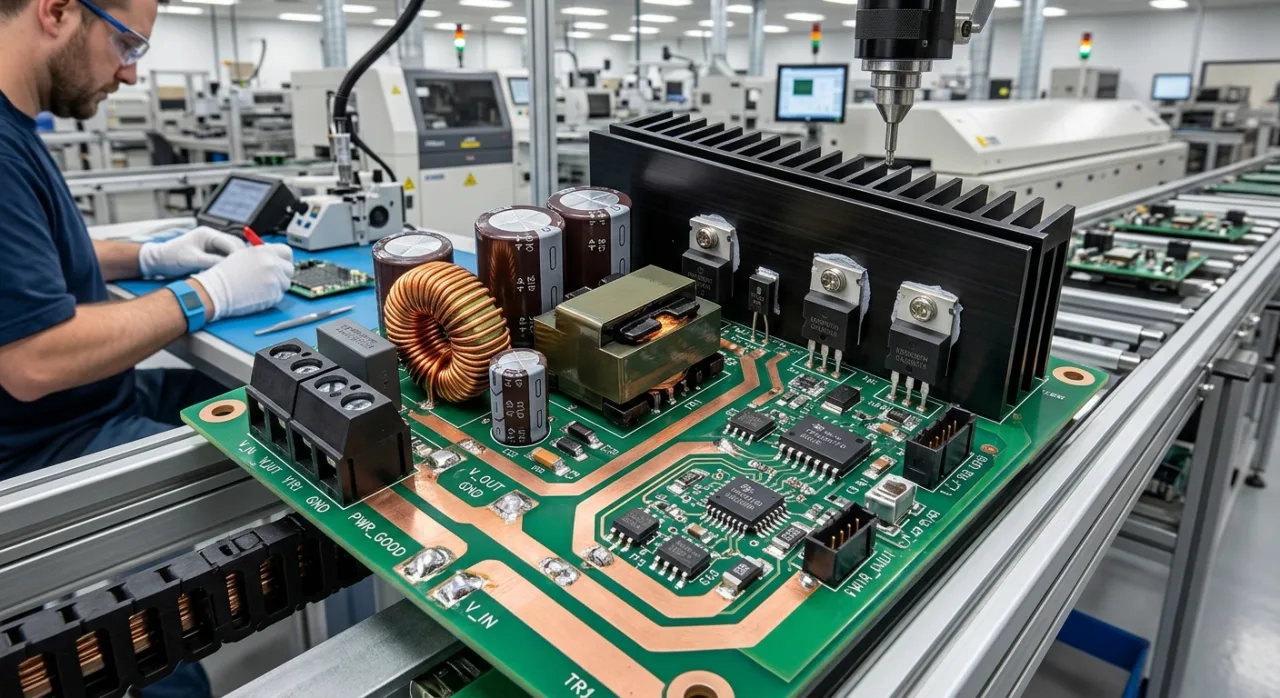
The manufacturing workflow begins long before components touch solder. Precision engineering and rigorous supply chain oversight lay the foundation for robust power electronics.
-
Design for Manufacturing (DFM): Engineers carefully select board materials, copper weights, and layer counts based on precise current ratings and thermal dissipation needs. Heavy copper often two ounces per square foot or more is standard where traces must carry tens of amperes without excessive heating. Wide trace routing, generous electrical clearances, and strategically placed thermal vias help disperse heat away from switching transistors, diodes, and transformers before component placement begins.
-
Component Selection and Derating: Power semiconductors like MOSFETs, IGBTs, and rectifier diodes are chosen for optimal voltage ratings, low on-state losses, and fast switching speeds. Capacitors and inductors are sized to manage ripple current and energy storage. Engineers implement strict derating strategies, operating components well below their maximum rated thresholds so the finished board can withstand voltage spikes, thermal swings, and years of continuous operation without premature failure.
-
Supply Chain Sourcing: Power electronics often feature long lead times and strict authenticity requirements, compelling manufacturers to buy exclusively from authorized distributors and verify incoming components against published datasheets. Planning for component lifecycles is equally vital; a power board designed for a decade-long service life requires active parts availability or a qualified second source to prevent production stoppages.
2. Fabrication and Core Assembly Stages
Once the schematic and layout are finalized, physical production transforms raw materials into a functional power distribution module.
-
Bare Board Fabrication: Copper layers undergo etching, drilling, and plating processes, followed by the application of a protective solder mask and an identifying silkscreen. For power boards, plated through-holes and thick copper plating are essential because they carry high currents between layers while providing structural support for heavy components like transformers, chokes, and large electrolytic capacitors.
-
Surface-Mount (SMT) Operations: Assembly operations typically start with solder paste printing. A precision stencil deposits a controlled volume of paste onto each pad, after which automated pick-and-place machinery positions surface-mount components with high accuracy. Paste volume control is critical here: insufficient paste creates weak joints under heavy components, while excessive paste can bridge closely spaced pins on power integrated circuits and cause short circuits.
-
Reflow Soldering: The populated board passes through a temperature-controlled oven where the solder paste melts, wets the leads, and solidifies into strong joints. Power boards introduce unique thermal challenges during this step because large internal copper planes absorb substantial heat. The reflow profile must be carefully tuned to bring heavy sections up to soldering temperature without overheating small, heat-sensitive components located elsewhere on the board.
-
Through-Hole Integration: Many power boards require through-hole assembly methods. Large connectors, heavy terminal blocks, and heat sinks are inserted into plated holes and soldered via wave soldering or selective soldering techniques. Because these joints must withstand ongoing mechanical stress from connected cables and operational vibration, quality inspection focuses heavily on achieving complete hole fill and robust solder fillets.
3. Thermal Management, Protection, and Environmental Shielding
Because power boards operate under high electrical stress, active thermal management and environmental hardening are critical for field longevity.
| Protection Method | Primary Purpose | Key Application / Technique |
| Thermal Management | Disperses excessive heat away from active switching components. | Heat sinks attached via thermal paste or adhesive pads; metal baseplates for high-load designs. |
| Conformal Coating | Shields internal circuitry from airborne moisture, dust, and corrosive agents. | Thin polymeric spray or dip applied to boards destined for harsh operating environments. |
| Potting Compounds | Physically anchors heavy components and blocks severe mechanical vibration. | Encapsulation resins that fill enclosures to protect against shock and extreme environments. |
Engineers verify thermal dynamics using infrared imaging and temperature sensors, confirming that no component exceeds its rated thermal limits under full load conditions in maximum ambient temperatures. Furthermore, both coating and potting treatments require careful application to prevent heat trapping or interference with connectors, trimmers, and manual adjustment points.
4. Quality Assurance, Testing, and Prototyping
Rigorous testing confirms the structural and electrical integrity of the completed power assembly before it leaves the factory floor.
-
Inspection Checkpoints: Automated optical inspection verifies component placement, correct polarity, and solder fillet quality, while advanced X-ray inspection reveals hidden joints beneath large packages like ball grid arrays and power modules. Any assembly failing these inspections is routed to a specialized rework station where technicians repair joints under microscopes before re-testing the board.
-
Electrical and Functional Testing: In-circuit testing screens for shorts, opens, and correct component values, while functional testing powers the board under actual load to measure output voltage, ripple, conversion efficiency, and protection responses. Overcurrent, overvoltage, and overtemperature protection circuits are intentionally triggered to verify they respond correctly before a fault can damage the board or its host equipment.
-
Safety and Compliance Testing: High-voltage sections require proper isolation barriers, safe creepage and clearance distances, and insulation ratings that comply with target market standards. Hipot testing applies a high voltage between isolated circuit domains to verify that the insulation holds under stress, with results logged as part of formal quality documentation.
-
Prototyping and Traceability: Before committing to full-scale production, a prototype run validates the initial design. Engineers assemble a limited batch, measure operational efficiency and thermal performance, and compare empirical data against design simulations. Discovering design flaws early is vastly more cost-effective than making changes after tooling and volume orders are finalized. Comprehensive documentation records specific component lots, solder materials, test results, and rework histories to ensure complete traceability.
Future Outlook
Power board assembly continues to evolve as wide-bandgap semiconductors like gallium nitride (GaN) and silicon carbide (SiC) enable higher switching frequencies and smaller magnetic components. These advanced materials promise more efficient, compact power electronics, but they also demand tighter layout control and innovative manufacturing techniques, ensuring that power design and factory assembly continue to advance hand in hand.
Leave a Reply